Win the room before entering! Talk to an expert to find out how! Medical brands that get found, trusted, and chosen don't wait ...
Fractional Medical Copywriter + AI Visibility: The B2B Medtech Edge in 2026
Discover why B2B medtech, pharma & healthcare facilities are choosing a fractional strategic copywriter with AI visibility expertise over a full marketing team... even before sales reps make a single call.
AEO
Annette J
5/27/202611 min read
94% of B2B buying committees rank their preferred vendors before speaking to a single sales representative — and they built that shortlist inside an AI answer engine, not on your website.
For medtech companies, pharma vendors, and healthcare facility suppliers, this is not a future problem. It is today's lost pipeline. By the time your sales rep makes contact, the clinical director or procurement lead has already asked ChatGPT, Perplexity, or Gemini which vendors are credible in your category. If your business wasn't cited in that answer, you weren't on the list.
This article explains what it takes to be named in that answer. And why a fractional strategic copywriter with AI visibility expertise is the specialist role that delivers it, where a full marketing team cannot.
What Is a Fractional Medical Copywriter + AI Visibility Specialist?
94%
Of B2B buying committees rank vendors before speaking to a sales rep.
6sense, 2025
89%
Of B2B brands are not yet optimized for AI discovery visibility
6sense / BrightEdge, 2026
5.1x
Higher conversion rate from AI search traffic vs. Google organic
Exposure Ninja / Loganix, 2026
A fractional medical copywriter with AI visibility expertise is a senior specialist who produces full B2B marketing collateral — white papers, case studies, sales decks, web copy, email sequences, LinkedIn content — while simultaneously architecting every piece of content to be cited by large language models (LLMs) like ChatGPT, Claude, Perplexity, and Gemini when your target buyers research vendors.
The "fractional" structure means the specialist works with your business on a retainer basis; without the overhead, ramp-up time, or fixed cost of a full-time hire. The "AI visibility" component means every piece of collateral is built not just to persuade a human reader, but to be extracted, cited, and surfaced by AI answer engines in the exact moments your buyers are shortlisting vendors.
This is a distinct role. It is not a medical writer who adds keywords. It is not an SEO agency that produces content briefs. It is the integration of three disciplines: clinical copywriting fluency, AEO architecture, and B2B growth strategy, operating as one unified function.
Why This Role Is Different From a Medical Writer or SEO Agency
A medical writer produces accurate, compliant content. An SEO agency optimises for Google rankings and organic traffic. Neither is trained to connect copy strategy to LLM citation behaviour — and neither is accountable for pipeline outcomes.
A fractional strategic copywriter with AI visibility expertise is accountable for all three: the clinical credibility of the content, its structural readiness for AI extraction, and its role in moving a complex B2B medical deal forward.
What "AI Visibility" Means for B2B Medical Companies
AI visibility is the measurable presence of your brand in AI-generated answers when your target buyers ask vendor evaluation questions. It is tracked as "Share of Model" — how consistently your company is named across ChatGPT, Perplexity, Gemini, and Google AI Overviews for the queries your buyers actually use.
For a medtech company, that might mean appearing when a health system IT director asks: "Which clinical workflow platforms have the strongest HIPAA compliance documentation?" For a pharma vendor, it might mean being cited when a procurement lead asks: "What are the most credible CRO partners for Phase II oncology trials?"
If your content isn't structured to answer those questions authoritatively, you will not be cited. And if you are not cited, you do not exist in the research phase that determines the shortlist.
How B2B Medical Buyers Actually Research Vendors in 2026
The B2B buying journey has always had a substantial independent research phase. What changed in 2025 and 2026 is where that research happens.
73% of B2B buyers now use AI tools somewhere in their vendor research process, according to a March 2026 analysis of 680 million citations. 51% of B2B buyers now begin their vendor research with an AI chatbot more often than with Google: up from 29% just twelve months earlier.
For B2B medical companies with average deal sizes above $100K and sales cycles measured in quarters, these numbers represent a structural shift in when and how your buyers form opinions about your category and your competitors.
The Pre-Shortlist Phase Your Funnel Doesn't Track
A Forrester survey of business buyers found that 94% of the B2B buying journey completes before the buyer contacts a vendor. And that figure increases when AI tools provide the synthesized comparisons that previously required multiple site visits.
Other research puts the independent research phase at 65–75% of the journey. One analysis frames it as roughly five hours of independent research for every one hour a buyer spends with a vendor's sales team. And the majority of that research now happens inside AI conversations, not on your website.
This is the phase your CRM cannot track, your retargeting pixels cannot see, and your sales team cannot influence. It is also the phase that determines whether you get a call at all.
Why Healthcare Buyers Trust AI Answers Over Vendor Websites
B2B medical buyers: hospital administrators, clinical directors, IT leads, pharma procurement teams, are trained to be sceptical of vendor-produced content. They understand that a vendor's website exists to sell.
AI-generated answers carry a different implicit authority. The buyer is asking a neutral system to synthesize available evidence. When that system names your company as a credible vendor, it carries more weight than your own case study ever could.
The practical consequence: buyers who arrive at a sales call having seen your company cited in AI answers arrive pre-sold on your credibility. Buyers who didn't see you cited arrive with a competitor already in first position.
Why AI Cites Some Medtech Brands and Ignores Others
AI answer engines do not cite websites randomly. They apply specific selection criteria — and most B2B medical companies, even those with substantial marketing investments, fail those criteria at every level.
What LLMs Look For: Authority, Structure, and Information Gain
The research is consistent across platforms. LLMs prioritize:
Domain authority: 65.3% of ChatGPT's top-cited pages come from domains with DR80 or higher, meaning earned media placements and third-party citations are foundational.
Statistical specificity: Adding statistics to content improves AI citation rates by 30–40%, according to Princeton and Georgia Tech research
Structured answers: Content formatted with direct answers under question-based headings, FAQ schema, and clear H2/H3 hierarchies is significantly more likely to be extracted
Information gain: Generic, summarized content does not earn citation. Content that answers a specific buyer question with data that cannot be easily found elsewhere earns citation.
E-E-A-T signals: Experience, Expertise, Authoritativeness, and Trustworthiness — the same framework Google uses — is also how LLMs assess whether a source is worth citing in a high-stakes category like healthcare
Why Siloed Marketing Teams Can't Build This Signal
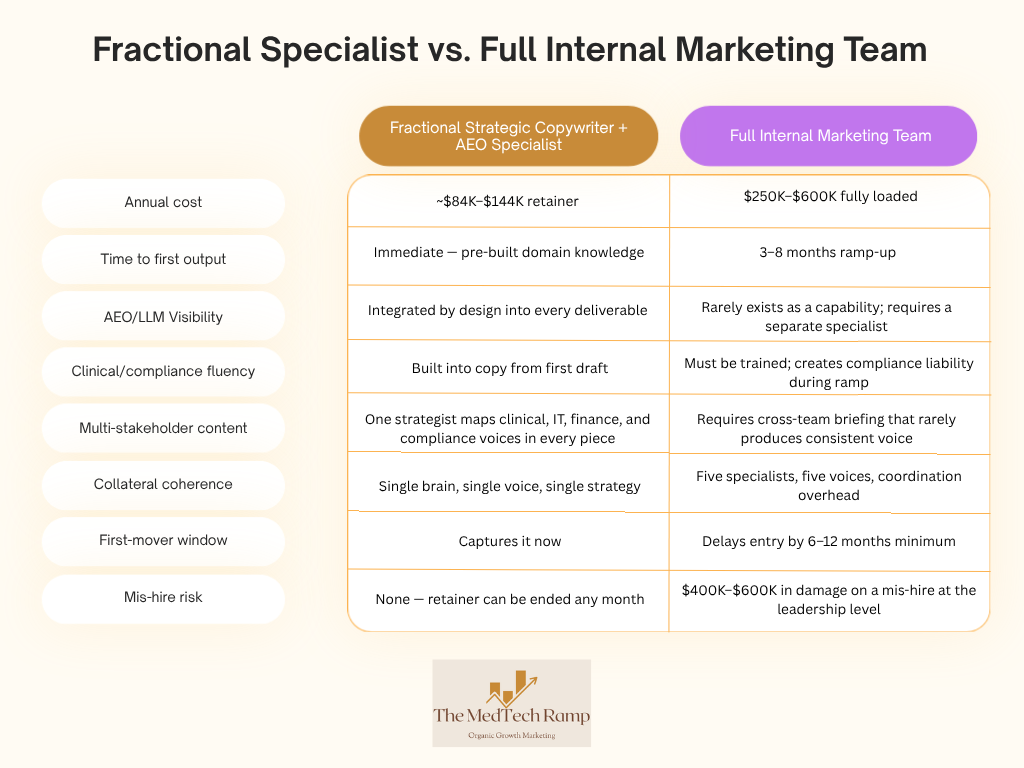
The structural problem with a full marketing team is not effort or talent - it is integration. When a copywriter writes collateral, an SEO specialist optimizes pages, a content team produces articles, and an AEO consultant advises separately, the result is fragmented authority.
LLMs do not cite fragmented campaigns. They cite unified brand entities that demonstrate consistent expertise across a topic.
In B2B medical, this fragmentation is compounded by compliance requirements. Content that hasn't been written with clinical accuracy and regulatory awareness from the first draft creates both a compliance liability and a credibility deficit in the eyes of the LLMs assessing E-E-A-T.
A fractional specialist who holds copywriting, AEO architecture, and clinical domain knowledge in one brain produces unified, citable content by default. A team of five produces coordination overhead and inconsistent voice.
The First-Mover Window. And How Long It Stays Open
When a competitor publishes 100+ interlinked, AEO-structured pages in your category before you do, AI systems develop a preference for citing that source. Reversing that preference requires outbuilding the existing authority, which takes 6–12 months of sustained production.
89% of B2B brands are not yet optimized for AI discovery visibility. In B2B medical specifically, that gap is wider still; the category has been slower to adopt AEO than B2B SaaS. That makes the window for MedTech companies larger, and the cost of inaction compounding by the quarter.
What a Fractional Specialist Delivers vs. a Full Team
Full Marketing Collateral - Built for Citation, Not Just Conversion
Every deliverable a B2B medical business needs at each stage of a 14.7-month sales cycle:
Top of funnel: Thought leadership articles, LinkedIn content, industry commentary — all structured for LLM citation, all written with clinical fluency
Middle of funnel: White papers, technical guides, comparison content, role-specific explainers for clinical, IT, finance, and compliance stakeholders
Bottom of funnel: Case studies (published as indexed web pages, not gated PDFs — because LLMs cannot read content behind a form), ROI frameworks, sales decks, proposal templates
Sales enablement: Email sequences, one-pagers, battle cards — written so the rep who makes first contact is validating what the buyer already believes, not introducing the concept from scratch
AEO Architecture: Every Piece Structured for LLM Discovery
This is the layer most marketing teams don't have. Every piece of collateral is built with:
Question-based H2 and H3 headings that match actual buyer queries
Direct, citable answers in the first 1–2 sentences under each question
FAQ sections with JSON-LD schema markup ready to implement
Statistical anchoring with source attribution in every key claim
Topic cluster structure — each article links to and from a master pillar page — so LLMs read concentrated, interconnected authority, not isolated pages
Pre-Sales Pipeline Activation: Named Before the Rep Calls
The strategic objective is to ensure that when your sales rep calls a clinical director or procurement lead, that person has already encountered your company's name in an AI-generated answer to a question they asked independently.
AI search traffic converts at 14.2% compared to Google organic's 2.8%. That's a 5.1x conversion advantage. And visitors referred by AI tools spend 68% more time on websites than visitors from other sources. These are not casual browsers. They are buyers who arrived already educated, already partly sold, and already on a shorter path to decision.
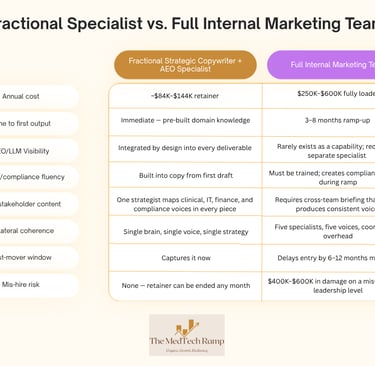
Why Integration Is the Moat. Not Headcount
The most important insight in B2B medical marketing in 2026 is not a tactic. It is a structural principle: the connection between copy, content architecture, AI visibility, and sales pipeline is a single discipline — not four separate ones.
The Copy-Content-Visibility Connection
Consider what it takes for a single piece of content to achieve what B2B medical companies need from it:
It must be written with the clinical precision and regulatory awareness that earns credibility with a committee of 22 decision-makers
It must be structured: With headings, schema, internal links, answer format; so LLMs extract it as a citation when buyers ask vendor evaluation questions
It must serve a specific stage in a 14-month sales cycle: top, middle, or bottom of funnel - without undermining the other stages
It must be consistent in voice and authority signal with every other piece of content the brand has published, because LLMs assess authority holistically
A copywriter who doesn't understand AEO writes compellingly for a human reader and gets ignored by every AI answer engine. An AEO specialist who doesn't understand clinical B2B produces technically structured content that no procurement committee trusts. A growth strategist who doesn't connect those two disciplines to actual collateral produces a visibility strategy with no execution.
The fractional specialist who holds all three disciplines in one brain is not a compromise. They are the only role that produces what the B2B medical market now requires.
What Breaks When These Disciplines Are Siloed
In practice, here is what siloed teams produce:
Case studies locked behind lead capture forms: invisible to LLMs, which cannot read content behind a gate.
White papers published as PDFs: unsearchable, uncrawlable, uncitable by any AI engine
Blog content written for keywords, not for buyer questions: ranked by Google, ignored by ChatGPT and Perplexity
Thought leadership that doesn't cite data: compelling to a human skimmer, dismissed by LLMs that prioritize statistical evidence
Multiple content domains and microsites that fragment authority signals; when LLMs reward concentrated expertise on a single domain, fragmentation is a direct visibility penalty
None of these are failures of effort. They are failures of integration.
Common Misconceptions About B2B Medical Marketing and AI Visibility
"Our Buyers Don't Use AI Tools"
This was plausible in 2023. It is contradicted by every major buyer behavior study published in 2025 and 2026.
85% of B2B buyers aged 25–34 use AI tools for supplier research. Even among buyers aged 55–64 — the demographic most likely to include senior clinical and procurement decision-makers in established health systems; 23% now use AI in their vendor research process. That number is growing in every cohort, every quarter.
More practically: even if a specific buyer at your target account doesn't personally use AI, other members of their buying committee do. In a committee of 22, the probability that nobody used ChatGPT to research your category is negligible.
"We Already Have an SEO Agency"
SEO and AEO optimize for different outcomes and are measured by different metrics.
SEO targets rankings and clicks: keyword density, backlink profiles, domain authority, and click-through rates. AEO targets AI citations and share of voice: question coverage, answer completeness, structured data, and brand mentions in AI-generated responses.
A page can rank first in organic search and be completely absent from the AI answer above it. An SEO agency optimising for rankings is not optimising for LLM citation, and in B2B medical, where buyers are now beginning their research in AI engines 51% of the time, that distinction is the difference between being on the shortlist and being invisible.
"We Need a Full Team to Produce Enough Content"
Volume is not the bottleneck. Authority is.
One well-structured, data-rich, clinically credible article that answers a specific question your buyer committee actually asks will earn more LLM citations than twenty generic thought leadership pieces written to fill a content calendar. The research confirms this: early AEO adopters are seeing 287–415% ROI within 90–120 days — not through content volume, but through content precision.
A fractional specialist producing 4–6 strategically architected pieces per month will outperform a full content team producing 20 unfocused pieces every time: because the LLMs are selecting for depth and authority, not frequency.
Frequently Asked Questions
What is a fractional medical copywriter?
A fractional medical copywriter is a senior B2B copywriter who works with healthcare, medtech, or pharma companies on a part-time or retainer basis, producing full marketing collateral without the cost or commitment of a full-time hire. In 2026, the most effective fractional medical copywriters also hold AI visibility expertise — meaning they structure every piece of content to be cited by LLMs like ChatGPT, Claude, and Perplexity when B2B buyers research vendors.
How do medtech companies get cited in ChatGPT and Perplexity?
Medtech companies earn LLM citations by publishing content that answers specific buyer questions with statistical evidence, clear structure, and clinical authority. Key tactics include: question-based H2/H3 headings, direct answers in the first sentence under each question, FAQ sections with structured data markup, ungated case studies published as indexed web pages, and topic cluster architecture that concentrates authority on a single domain. Content behind forms or in PDF format is invisible to AI engines.
What is AEO and why does it matter for B2B healthcare?
Answer Engine Optimization (AEO) is the practice of structuring content so AI-powered answer engines: ChatGPT, Perplexity, Gemini, Google AI Overviews, and others - extract, cite, and surface it when users ask questions. For B2B healthcare companies, AEO matters because 73% of B2B buyers now use AI tools in their vendor research process, and AI search traffic converts at 5.1x the rate of traditional organic search. A medtech company not optimized for AEO is invisible to the majority of its potential buyers during the most influential phase of their decision-making.
How is a fractional AEO copywriter different from hiring an SEO agency?
An SEO agency optimizes for search engine rankings and organic traffic. A fractional strategic copywriter with AEO expertise optimizes for LLM citation, brand authority in AI answers, and pipeline outcomes, while also producing the full spectrum of collateral a B2B medical sales cycle requires. SEO and AEO are complementary but distinct disciplines. In B2B medical, where buyers now begin research in AI engines more often than in Google, AEO is the higher-leverage investment.
How soon can AI visibility impact B2B medical pipeline?
AI visibility begins compounding immediately but typically produces measurable citation increases within 60–120 days of consistent, properly structured content production. One B2B technology company increased AI referral traffic by 70% in four months using integrated AEO tactics. The more important timing question is competitive: the first company in a B2B medical category to build authoritative LLM citation positioning locks in a 6–12 month advantage that competitors cannot reverse quickly. 89% of B2B brands have not yet started.
The Answer Your Buyer Gets Before You Call
The B2B medical buyer journey now has a phase that precedes your website, your ads, your sales cadence, and your trade show presence. It happens inside an AI conversation, in a private browser session, in the office of the procurement lead who will never tell you it happened.
In that conversation, your company is either named or it isn't.
Building that presence requires content that is clinically credible enough to earn the trust of a 22-person buying committee, structured precisely enough to be extracted by an LLM, and strategically coherent enough to move a 14-month deal forward — all at once. That is not a task that can be distributed across five specialists who don't share a brain. It is a task for one specialist who holds all three disciplines as a single integrated practice.
MedtechRamp works with B2B medtech, pharma, and healthcare facility vendors to build the AI visibility and marketing collateral that gets you shortlisted even before the sales call begins.
Annette Jacintha
MedTech Marketing Consultant
Contact
© 2026 MedTechRamp. All rights reserved.